
Diversion of MGR for NTPC Kahalgaon Super Thermal Power Plant (Stage-II, 3×500 MW)
The Merry-Go-Round (MGR) railway system at NTPC Kahalgaon, conceived to transport coal from the Lalmatia mines to the plant, was originally a single-line alignment with loading and unloading bulbs at either end. Although provision had been made for doubling on the western side, the system was recurrently imperilled by severe floods—notably in 1993, 1995, and 1999—which repeatedly devastated the stretch between km 4.50 and km 10.50, causing prolonged suspensions of coal movement and crippling plant operations.
To address this vulnerability, NTPC engaged RITES to conduct a flood mitigation study, which culminated in a report (May 2001) recommending the provision of 500 m of additional waterway openings in the critical stretch, together with a 1.0 m raising of formation levels at the lowest reaches. Subsequent deliberations led NTPC to adopt a more robust measure: the creation of a new diversion line across the affected zone, enabling traffic to be routed via the diversion while the existing track was raised and additional waterways inserted. The diversion itself was planned with provision for future doubling, thereby harmonising immediate flood resilience with long-term capacity augmentation.
In December 2004, NTPC formally entrusted to RITES the Project Management and Execution Consultancy for the work titled “Construction and Construction Supervision for Diversion and Re-grading of the Flood-Affected Portion (km 4.50 to km 10.50) of MGR System for Kahalgaon STPP, Stage-II (3×500 MW).” While DPR and detailed engineering had been prepared through another agency, all technical data were handed to RITES for integration into project execution.
I was associated with this project from its inception and served as in-charge of the entire programme, overseeing all three geographically distributed packages along the km 4.50–10.50 stretch. My remit encompassed the preparation of tender documents, floating and finalisation of tenders, and comprehensive supervision of execution.
The project demanded not only technical governance and construction oversight, but also strategic management of flood-prone conditions, integration of waterways, and coordination with multiple stakeholders, ensuring that the diversion delivered both immediate relief and enduring resilience to NTPC’s critical coal transport artery.
The Kahalgaon MGR Diversion remains a distinguished example of RITES’ capacity—and my own stewardship—in reconciling civil engineering ingenuity with environmental exigencies, thereby fortifying the lifeline of a super thermal power plant against the vagaries of recurring floods.
Role of RITES
RITES functioned as the Project Management and Execution Consultant, entrusted with the comprehensive stewardship of the assignment. Its responsibilities encompassed tender packaging, floating and finalisation of bids, award and administration of contracts, vigilant supervision of works, rigorous quality and cost control, contract governance, and the prudent management and regulation of NTPC funds, in addition to the full spectrum of construction project management activities.
Construction of Koa River Bridge
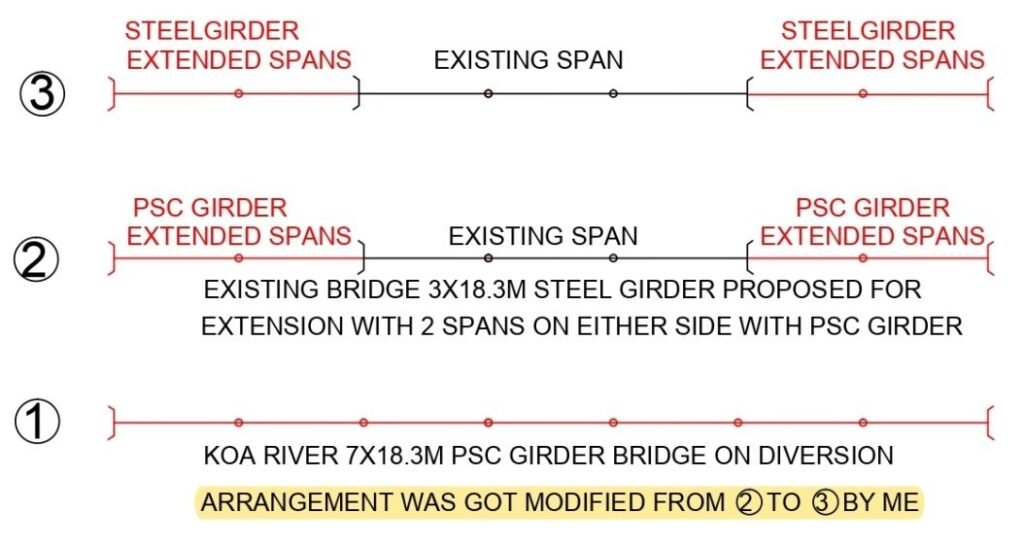
As part of the diverted alignment, a seven-span bridge was constructed to traverse the Koa River, while on the existing alignment the three-span steel girder bridge (3×18.3 m) was extended by two spans on either side, ensuring uniformity of waterway across both structures.
The 7×18.3 m bridge on the diversion was executed first. Its foundations comprised bored cast-in-situ piles of 1,000 mm diameter, each to a depth of 18 m, constructed using the direct mud circulation method. A total of 78 piles were installed—groups of 12 piles supporting each abutment and groups of 9 piles supporting each pier—with M-35 grade concrete employed for pile construction. For the substructure and ancillary elements, M-30 grade concrete was adopted.
The superstructure consisted of post-tensioned, pre-stressed concrete (PSC) girders, designed to RDSO Standard Drawing No. B-10247 for MBG Loading-1987. The girders were cast in M-45 grade concrete, while the diaphragms and deck slabs utilised M-30 grade. The bridge was equipped with elastomeric bearings (600 mm × 550 mm × 91 mm), seismic restrainers, and a footpath on the deck, integrating both functional and safety features.
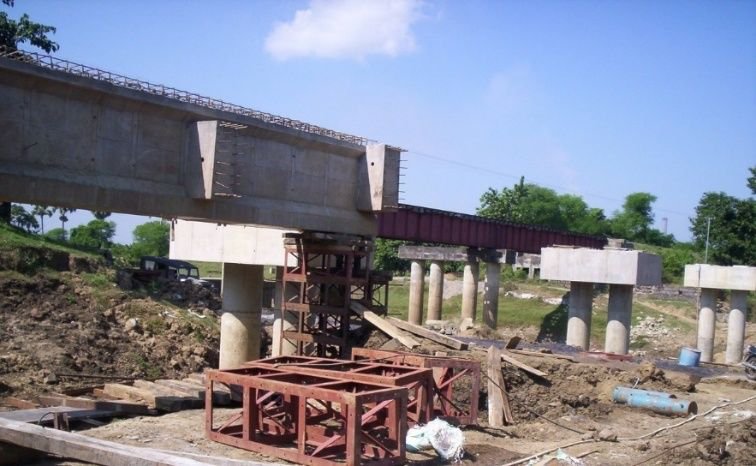
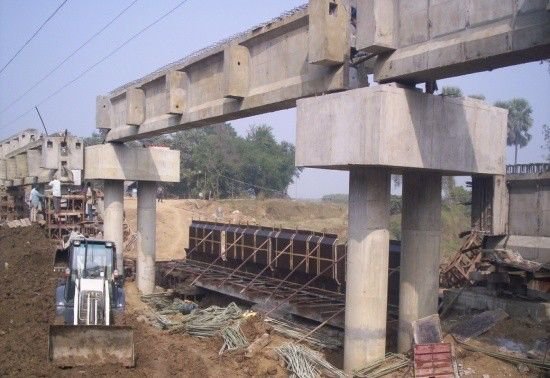
For pre-stressing, the Freyssinet (FPCC) system with multi-pull jacks was employed, with tendons stressed from both ends using 19T13 anchorage arrangements. The execution demanded precise alignment, rigorous quality assurance, and advanced construction methodology, culminating in a structure that embodied both engineering strength and construction finesse.
The Koa River Bridge today stands as a vital component of the MGR diversion works, symbolising the integration of innovative foundation engineering, state-of-the-art PSC technology, and robust project management in delivering resilient infrastructure for NTPC’s coal transport system.
Replacement of PSC Girders with Steel Girders in Extension of Existing Bridge
Two 20.0 m long service girders were originally proposed for procurement to facilitate their insertion on the existing MGR track during block periods at the locations of new openings for Bridge Nos. 17 F1 and 18 F1. These girders were intended to serve as relieving girders and would otherwise have remained as construction spares for NTPC’s future requirements.
It was proposed to procure 18.3 m Railway Standard Steel Girders in lieu of the service girders and utilize them in the extension of the existing bridge by substituting the proposed PSC girders on one side. Further, procurement of two additional spans of 18.3 m steel girders was suggested for use on the opposite side, thereby replacing all proposed PSC girders with steel girders. The proposal, accepted by RITES and NTPC, was implemented with the procurement of four spans of 18.3 m steel girders from the Railway Bridge Workshop, Northern Railway, Jalandhar.
This substitution ensured uniformity in girder type, simplified construction, and achieved economy. Consequently, the bridge on diversion remains a 7×18.3 m PSC girder bridge, while the existing bridge has been standardized as a 7×18.3 m steel girder bridge.
Diversion of MGR for NTPC Kahalgaon Super Thermal Power Plant (Stage-II, 3×500 MW)
The project involved diversion of the KBJ Railway Line, a passenger line of Eastern Railway (now East Central Railway), over a length of approximately 6.5 km near Shaktinagar Railway Station. The scope comprised construction of ten bridges, including four major bridges, earthwork in high embankment and cutting, pile foundations with 1.0 m diameter bored cast-in-situ piles involving rock drilling, and permanent way works. The work was awarded to RITES by Northern Coalfields Ltd. (NCL) on a turnkey basis.
This project represented the balance portion of works earlier partially executed by IRCON. The remaining works were taken up under my charge. Formation works were executed in accordance with RDSO guidelines, and works on Bridges Nos. 2, 3, 5, 6, 8, and 9 were initiated. Bridges Nos. 2, 3, 6, and 8 were completed. Bridge No. 5, a 12.2 m PSC girder bridge on pile foundation, had pile work completed on one abutment. Rails were also procured.
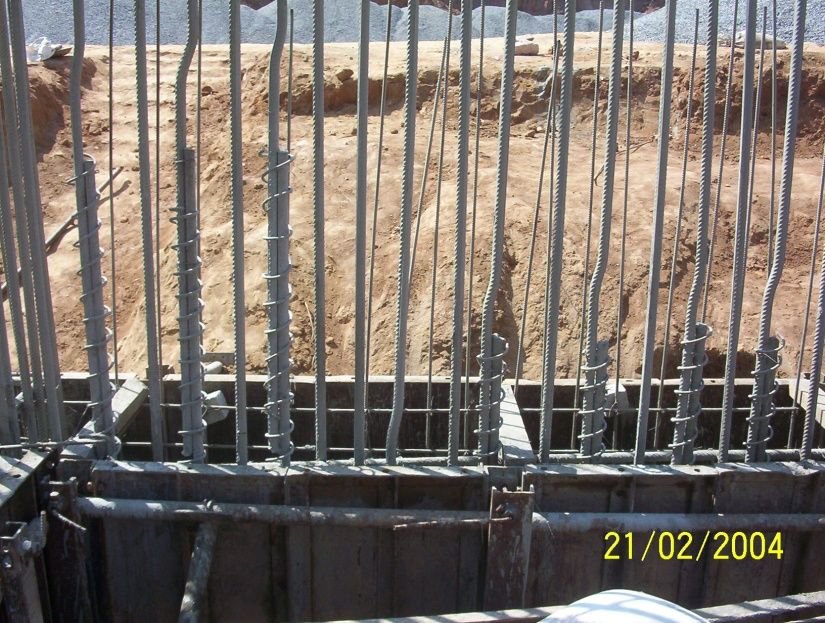
At several bridge locations, it was observed that reinforcing bars had been cut and removed by local villagers; these were subsequently extended through proper splicing in accordance with specifications. The assignment included day-to-day supervision, quality control, adherence to specifications, processing of claims, and certification of contractors’ bills. The work was executed during 2003–2004.
The site was subjected to intensive examination by the Central Technical Examiner’s (CTE) Organization of the Central Vigilance Commission. The CTE team appreciated the maintenance of site records, and after detailed correspondence, the case was closed with no adverse findings against any member of the RITES team. The contract, however, was foreclosed midway due to land acquisition constraints faced by NCL.
Upon resolution of these issues, Northern Coalfields Ltd. (NCL) once again approached RITES for completion of the balance works. RITES was re-engaged in September 2013 to provide Project Management Consultancy (PMC) services. Field works commenced in July 2014 and were completed in October 2015. As the section formed part of a passenger line, statutory clearance from the Commissioner of Railway Safety (CRS) was obtained, and the diverted line was commissioned and opened to traffic on 15.09.2018. The execution of this phase was undertaken by a different team of RITES.